Expanding the initiatives of the Challenge Carbon Neutral Consortium to address issues through supply chain collaboration
In FY2025, we continued our participation in the Challenge Carbon Neutral Consortium (CCNC). This initiative brings together manufacturers, distributors, and other companies as well as four prefectures and one designated city (Osaka, Hyogo, Nara, and Kyoto Prefectures and the City of Yokohama) to encourage consumers to choose eco-friendly products and actively engage in decarbonization efforts. By promoting greater awareness of and behavioral change toward decarbonization among consumers, the CCNC aims to accelerate the transition to a decarbonized society. As part of this initiative, we conducted “Eco Labeling Hunter 2025,” a learning kit and independent research contest designed to help participants learn about eco labeling and carbon footprints. In conjunction with this initiative, we also launched a quiz campaign through the SUGI Pharmacy app.
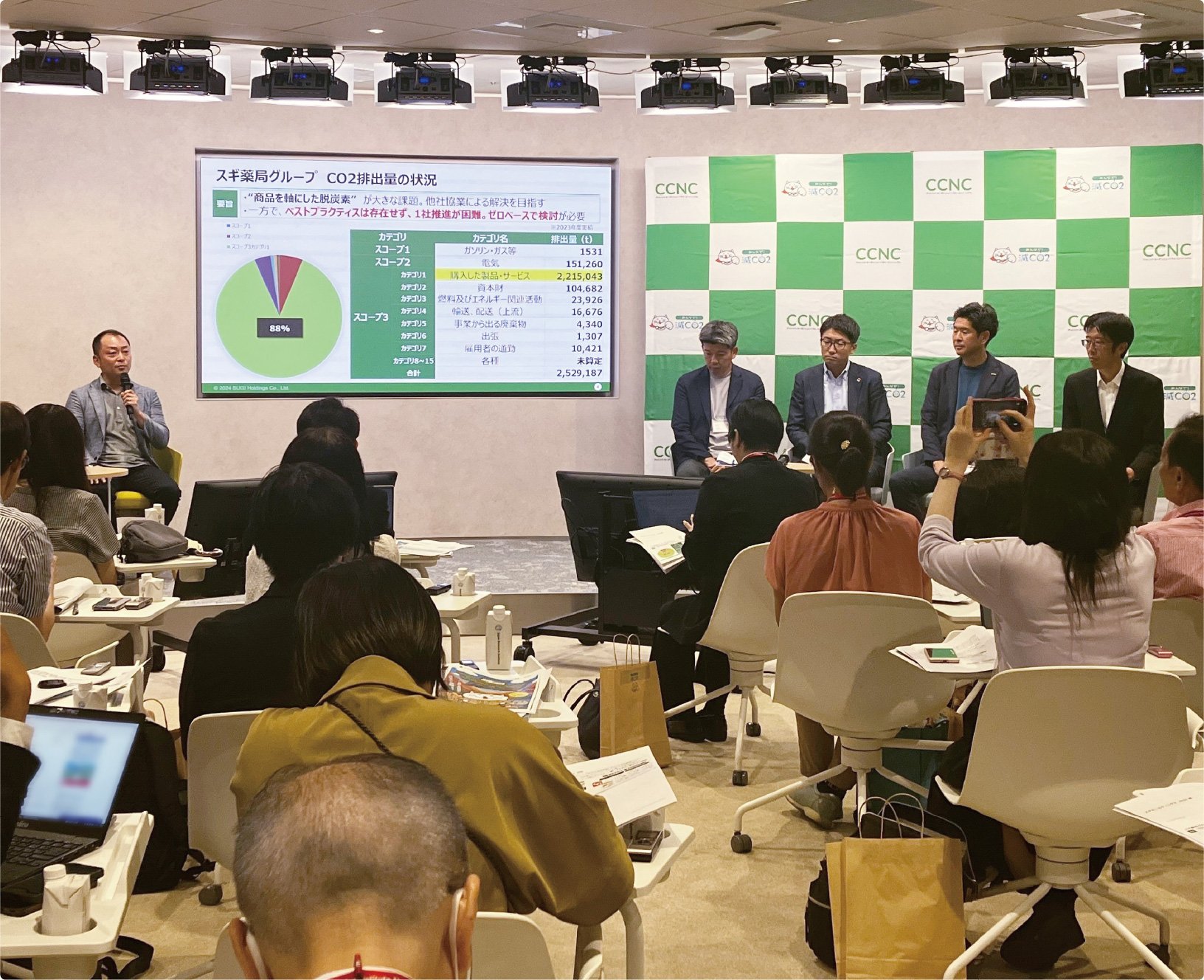 FY2025 Presentation panel discussion
 App testing
In FY2025, we conducted the “2nd Eco Labeling Master” program for all users of the
SUGI Pharmacy app. The number of participants nearly doubled compared to the previous fiscal
year, contributing to greater understanding of eco labeling.
Among the participants, we recruited “CO2 Reduction Monitors” who were willing to
cooperate with interviews and surveys regarding their environmental awareness and behaviors. These
monitors were also given the opportunity to provide direct feedback on eco labeling to companies
participating in the CCNC.
In the following fiscal year, we will engage with monitor members through both online and offline approaches to gather direct consumer feedback and will conduct purchasing behavior analyses using POS data and other sources. Through these analyses, we will quantitatively assess the impact of educational and awareness-raising initiatives on purchasing behavior. Based on these insights, we will develop and promote approaches aimed at fostering an autonomous decarbonization market that does not rely on financial incentives.
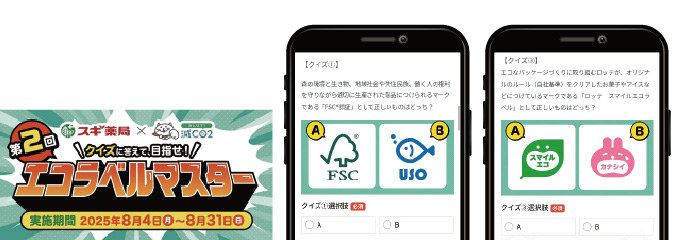
App contents to raise awareness of decarbonization

Shifting to renewable energy
With the goal of reducing CO2 emissions per store by 50% by FY2030 compared to FY 2014 levels, we are promoting the use of renewable energy through solar power generation. In addition to using on-site PPAs, we have been actively expanding the use of off-site PPAs since April 2024. Through these initiatives, we aim to achieve net-zero CO2 emissions per store by 2050. To realize a sustainable, decarbonized society, we will continue to expand our concrete and effective efforts moving forward.
-
Number of stores using renewable energy
369 stores(As of the end of February 2026) * In-house power generation + PPAs (on-site / off-site)
Metrics and targets
| CO2 emission reduction target per store | |
|---|---|
| FY2030 | 50% reduction from FY2014 |
| FY2050 | Net zero |

Solar panels installed on the rooftop of SUGI Pharmacy Fujimi Store

Solar panels installed on a store rooftop
First to receive BELS’ highest six-star rating and Nearly ZEB certification
SUGI Pharmacy Mikawa Anjo Minami Store, which opened in December 2025, became the first store in the Group to receive ZEB certification, achieving the BELS’ highest six-star rating and Nearly ZEB certification. By using high-efficiency LED lighting and air-conditioning systems, along with solar power generation, the store has reduced primary energy consumption by 81% compared to a standard reference building, achieving both a reduced environmental impact and a comfortable retail space.
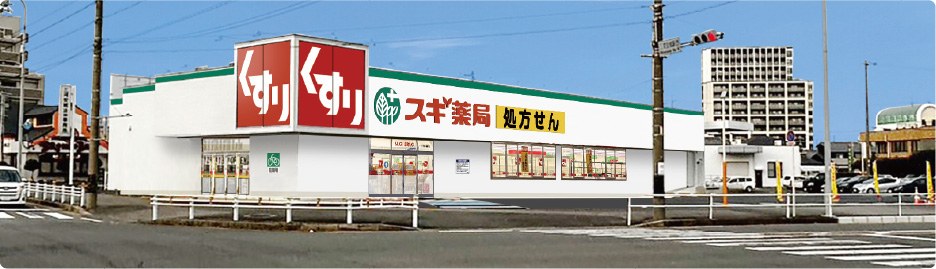
SUGI Pharmacy Mikawa Anjo Minami Store
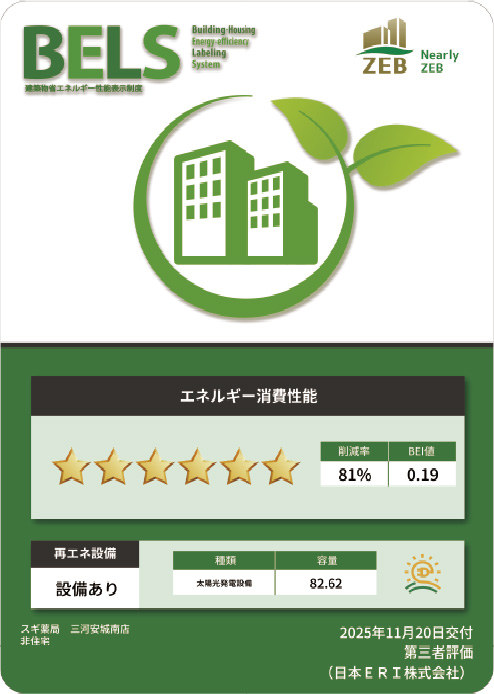
*ZEB (Net Zero Energy Building): A building that aims to achieve a net-zero balance of annual primary
energy consumption through the use of energy-efficient equipment and renewable energy
* BELS (Building-Housing Energy-efficiency Labeling System): A certification system under which a
third-party organization evaluates and labels the energy-efficiency performance of buildings
Reducing the consumption of fossil fuels
In order to reduce the consumption of fossil fuels by company cars, we have started to introduce electric vehicles (EVs). We will continue to expand the introduction of EVs, as well as hybrid vehicles. We have also introduced a mechanism to monitor the driving status of vehicles, such as sudden braking and starting, to seek safe driving and the reduction of fossil fuel consumption at the same time.
Introducing energy saving equipment and reducing power consumption (energy saving)
We are working to reduce power consumption by closely monitoring temperatures and regularly cleaning AC equipment at stores as well as the headquarters and other offices. We have also been working to replace conventional lighting with LEDs at all our stores since FY 2013. We will also replace old LEDs in due course in order to reduce power consumption and CO2 emissions further.
- LED introduction rate at end of February 2026
- 94.4%
- Target LED introduction rate
- 100%

Submission of declaration of voluntary action for “white logistics” promotion campaign
In August 2021, the SUGI Pharmacy Group submitted a voluntary action declaration in support of the “white logistics” promotion campaign advocated by the Ministry of Land, Infrastructure, Transport and Tourism, the Ministry of Economy, Trade and Industry, and the Ministry of Agriculture, Forestry and Fisheries. In 2023, we introduced MOVO Fleet, a dynamic management service, to realize sustainable logistics. This has enabled us to visualize the status of deliveries from distribution centers to the stores, to monitor drivers’ compliance with laws and regulations, and to optimize delivery times and routes. By establishing a safe and efficient delivery system, we strive to ensure stable logistics in harmonious coexistence with local communities.

Chief distribution center attached to the Chubu Head Office
Specific actions set forth in SUGI Pharmacy’s voluntary action declaration
| Action items | Details of efforts |
|---|---|
| Logistics improvement proposals and cooperation | If there are any requests from business partners or logistics companies regarding manual unloading by truck drivers, the rationalization of ancillary work, etc., we will diligently discuss the matters with them and actively propose solutions. |
| Introduction of reservation reception system | The Company will reduce truck drivers’ waiting time by introducing a truck reservation reception system. |
| Use of pallets, etc. | Use of pallets, etc. |
| Provision of receiving/shipping information from business partners in advance | We will secure adequate work hours for on-site workers and truck drivers to allow them to complete their work and delivery without undue time constraints in order to promote the rationalization of logistics by requesting business partners to share quantity information and data with the distribution center in advance. |
| Leveling order quantity | To reduce cargo waiting time and improve operation efficiency, the Company will level out the difference in busyness, such as by equalizing the quantity of cargo per day and month. |
| Promotion of documented transportation contracts | When selecting a logistics company to contract with, the Company will promote legal compliance by mutually confirming relevant laws and regulations. |
Implementing shared warehousing and collaborative distribution
Addressing the logistics industry’s “2024 Problem” and climate change is a critical responsibility for retailers that support social infrastructure. In collaboration with beverage manufacturers and other partner companies, the Group has established a shared warehousing and collaborative distribution scheme for certain beverage deliveries, moving beyond conventional industry practices.
Through this initiative, we have consolidated transportation routes and improved load efficiency. Specifically, we use partner companies’ facilities as shared warehouses, consolidate product inventories, and transport them in bulk to the Group’s distribution centers using large-capacity vehicles (collaborative distribution), thereby maximizing load efficiency. As a result, we have successfully optimized logistics costs by reducing the number of delivery vehicles, while achieving a significant reduction in CO2 emissions. At the same time, reducing the frequency of deliveries helps alleviate drivers’ loading and unloading workloads as well as waiting times, contributing to the development of a sustainable and resilient logistics system.

Extending lead times and relaxing delivery deadlines (1/2 rule)
To maintain stable supply in the future, it is essential to review conventional business practices that place a burden on logistics operations and transition to a system in which manufacturers, vendors, and retailers can collaborate smoothly. From the perspective of total supply chain optimization, the Group is promoting the extension of lead times and the relaxation of delivery deadlines (1/2 rule).
We have extended the lead time from order placement to delivery from “next-day” to “the day after next or later,” thereby introducing greater flexibility into delivery schedules. As a result, the lead time for products arriving at stores has been changed from the conventional two days to three days. This initiative has significantly contributed to reducing long working hours for truck drivers and decreasing the number of required trucks.
Furthermore, as part of our efforts to reduce food loss, we have adopted the “1/2 rule” for certain beverage manufacturers, extending the delivery deadline from the first one-third to one-half of the product’s shelf life. By expanding the allowable receiving period, we are contributing to reducing waste risk across the entire supply chain. Going forward, we will continue to work hand in hand with our partner companies to establish logistics practices aligned with the times, thereby contributing to the realization of a sustainable society in which everyone can work without undue burden.
