Drug Station,
automated medicine picking equipment
To pursue safety and efficiency, we have introduced Drug Station into large-scale prescription dispensing pharmacies.
Features
- Accurate picking on the spot
- No need to worry if there is any error
- Safety ensured by the checking function


Shinshu University Store


Sugi Clinic Mall Kanayama Store
Serving as “local alliance pharmacies” and “pharmacies allied with specialized medical institutions”
We have focused on serving as “local alliance pharmacies” and “pharmacies allied with specialized medical
institutions.” By utilizing our accumulated know-how of prescription dispensing, we are increasing the
number of stores providing a home-visit prescription dispensing service. We are proceeding with the
development of local alliance pharmacies that can serve as local healthcare hubs by sharing patients’
detailed information with the relevant medical institutions at the time of their hospital admission and
discharge and by providing comprehensive support in the phases of elderly nursing care and terminal
care.
We are also making efforts to create “pharmacies allied with specialized medical institutions.” Featuring
high-level pharmaceutical management functions, such pharmacies are involved in the development of
specialized pharmacists in the field of oncology and work in closer cooperation with medical institutions
providing specialized medical care.
- Pharmacies allied with specialized medical institutions
- 14stores
- Local alliance pharmacies
- 100stores
Interview
As a Board-certified Pharmacist of Ambulatory Cancer Chemotherapy, I work closely with hospitals, actively monitoring side effects through tracing reports and making prescription suggestions to create a system that allows patients to continue their treatment with peace of mind.
Leveraging my expert knowledge, I support hospitals in accurately understanding the condition of outpatients, enabling safe and high-quality pharmacotherapy. I am confident that my role as a bridge between hospitals and pharmacies will significantly enhance the value of pharmacists in community healthcare.
Within the company, I lead the kidney disease team and share my knowledge across the company. Providing feedback on daily success stories and expertise, I contribute to developing the skills of less-experienced pharmacists and raising the overall level of expertise within the organization.
Our company has an environment where you can pursue advanced expertise in areas such as cancer, kidney disease, and nutrition while working on-site. Enhancing your expertise is the very reason why patients select you. I look forward to working with the next generation to explore new possibilities for pharmacists.
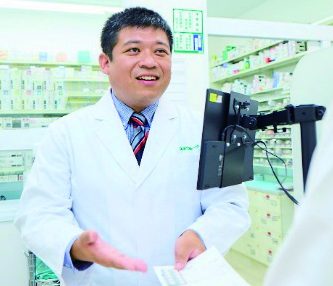
Board-certified Pharmacists of Ambulatory Cancer Chemotherapy
Qualifications
- Board-certified Pharmacists of Ambulatory Cancer Chemotherapy
- NST Specialized Therapist
- Board-certified Nephrology Pharmacy Specialist
- Certified Kidney Disease Educator
- Certified Diabetes Educator
Ensuring accuracy of ID confirmation based on an online qualification confirmation system
We have started online qualification confirmation based on IC chips of individual number cards or codes and numbers on health insurance cards. Having introduced card readers, we can now confirm necessary information on patients accurately and quickly.

Providing information in waiting rooms using digital tools
We promote the installation of digital signage in our waiting rooms to provide patients waiting for their prescriptions with information that will help them live a healthy life, including information on pre-symptomatic disease, disease prevention, and treatment.

Safely collecting medical and pharmaceutical products and medical equipment
In line with the needs of customers and patients, we are increasing the number of stores where
infectious waste (e.g., used injection needles) is collected. To prevent such collection from leading to
needle stick accidents, we have a framework for managing collected waste appropriately.
*We sell collection boxes to patients and collect the sold boxes.

Installing many more medicine pick-up lockers
By the end of February 2023, we had introduced the delivery locker system “Quist” at 76 stores as
prescription pickup lockers.
This service allows patients to receive prescriptions, at any time during the store’s business hours,
for which medication instructions have been given in-store or online. As awareness of non-face-to-face
and non-contact methods increases, we contribute to diversifying the ways patients receive their
medicines.

Fostering highly specialized experts such as pharmacists and nationally certified dietitians
To further promote community healthcare collaboration, we have established a new collaboration model centered on providing clinical experience for community pharmacists and nationally certified dietitians, mutually sharing know-how between hospitals and pharmacies, and supporting diverse career development for individuals. By having pharmacists and nationally certified dietitians from pharmacies seconded to local hospitals for six months to one year for educational purposes, the model ensures a win-win-win relationship for all three parties: human asset development for the pharmacy, improvement of operations for the hospital, and the realization of a new career opportunity for the seconded individual. Moreover, after completing their training, the seconded staff returns to the pharmacy and contributes to improving patients’ quality of life by sharing the advanced know-how they have cultivated at the hospital, such as medication guidance, nutritional and dietary support, and hospital admission/discharge coordination, with local healthcare players, thereby promoting seamless healthcare collaboration.

Industry-academia collaboration with Fujita Health University
We have accumulated practical experience in advanced medical settings at the university hospital, including side effect management in a pharmacist-led outpatient clinic in the field of oncology, and prevention of medical errors through perioperative pharmaceutical management. In addition, we are accumulating evidence through clinical research at the graduate level. Through these initiatives, we will continue to cultivate human resources with advanced expertise and interprofessional collaboration skills and lead the improvement of the quality of community healthcare.